Why This Question Matters More Than Ever in the Age of AI, Zero-Click Search & Changing Consumer Behaviour
For years, businesses approached marketing with a relatively straightforward mindset. If you had the time and enthusiasm, you could manage much of it yourself. You might post on social media, run some Google Ads, optimise a few website pages for SEO, and send occasional email campaigns. For many businesses, that was enough to generate visibility and enquiries.
But marketing in 2026 looks very different.
Today, businesses are operating in a digital landscape that is shifting faster than ever before. Search behaviour is changing, artificial intelligence is reshaping how people discover information online, and consumers are increasingly interacting with brands without ever visiting their websites. As a result, the question of whether to hire a marketing agency or continue managing marketing internally has become far more complex.
The Rise of Zero-Click Search
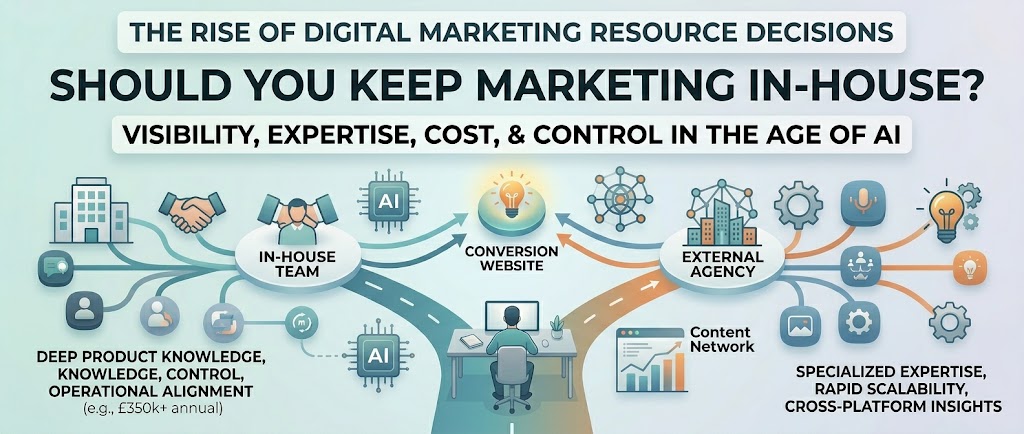
One of the biggest changes impacting businesses right now is the rise of “zero-click” search behaviour.
Increasingly, users are getting answers directly within platforms like Google AI Overviews, ChatGPT, Bing Copilot, LinkedIn, TikTok, and voice assistants without ever clicking through to a website. According to research published by Search Engine Journal, AI-generated overviews are already having a significant impact on organic click-through rates, with some studies suggesting click-through rates can reduce by as much as 30–40% when AI summaries appear within search results.
Search Engine Journal highlighted this shift in their article discussing how Google AI Overviews are reducing organic traffic visibility.
At the same time, Pew Research has reported that users are becoming increasingly comfortable consuming information directly within search interfaces rather than navigating through to external websites.
This means businesses can technically rank well on Google while still seeing website traffic decline.
Visibility is no longer just about ranking first. It is about being visible wherever consumers are searching, researching, asking questions, and interacting with AI-driven platforms.
Marketing Has Become Much Bigger Than SEO or PPC
For many businesses, marketing used to revolve around a handful of core channels. SEO, Google Ads, Facebook campaigns, and email marketing often formed the foundation of digital growth strategies.
Today, the landscape is far more fragmented.
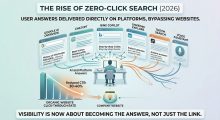
Consumers may first discover a business through an AI-generated answer, then check reviews on Google, browse LinkedIn content, watch short-form video, read testimonials, and only later visit the company website itself.
Modern marketing is now about building trust, authority, discoverability, reputation, and omnichannel visibility.
This shift is forcing businesses to think beyond simple rankings and impressions. Increasingly, brands need to establish themselves as trusted sources of information and expertise so that both consumers and AI systems recognise them as authoritative.
Why Businesses Are Struggling to Keep Up
The pace of change in digital marketing is now relentless. Google updates constantly. Meta advertising changes frequently. LinkedIn algorithms evolve. AI search tools are developing rapidly. Attribution models continue to shift, while automation increasingly replaces manual optimisation.
For businesses already focused on operations, staffing, sales, and customer service, staying ahead of all of this internally can become overwhelming.
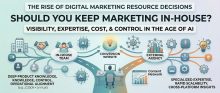
Research from UK consultancy Miles Marketing estimated that building and maintaining even a relatively modest in-house marketing team could cost SMEs between £320,000 and £380,000 annually once salaries, software, training, and overheads are considered.
For many businesses, this is where the appeal of external agency support begins to grow.
What Marketing Agencies Actually Provide Today
The role of a marketing agency is no longer simply to “run ads.” Modern agencies increasingly provide strategic direction, technical expertise, cross-channel integration, reporting, creative support, and guidance around AI visibility and discoverability.
Because agencies work across multiple industries and campaigns simultaneously, they are often exposed to emerging trends and platform changes earlier than individual in-house teams.
This broader perspective can help businesses adapt more quickly and avoid costly mistakes.
Agencies are also often able to scale activity faster without businesses needing to hire multiple internal specialists across SEO, PPC, analytics, content, automation, and technical optimisation.
AI Has Made Content Easier – But Differentiation Harder
Artificial intelligence has dramatically lowered the barrier to entry for content creation. Today, businesses can use AI tools to generate blog articles, ad copy, landing pages, social captions, videos, and automated email campaigns within minutes.
But while AI has made producing content easier, it has also flooded the internet with repetitive and generic material.
The result is that trust and differentiation matter more than ever.
Consumers are becoming increasingly exposed to templated content and generic messaging. The brands that are succeeding are not necessarily producing the most content – they are producing the most credible, insightful, emotionally resonant, and authoritative content.
Research into AI search disruption and changing online visibility trends has also highlighted growing concerns around content quality and discoverability.
AI can support execution, but it still struggles to replace strategic thinking, customer psychology, creativity, emotional intelligence, and genuine brand positioning.
Should You Keep Marketing In-House?
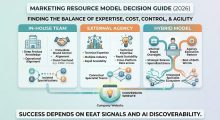
For some businesses, an internal approach absolutely still works. Founder-led brands, niche specialists, and businesses with strong in-house expertise may benefit from keeping marketing closely aligned to the internal team. Internal marketers often understand the product, customer base, and company culture more deeply than an external partner initially can.
However, modern marketing has become increasingly specialised.
A single business may now need expertise across SEO, PPC, analytics, AI search visibility, content strategy, automation, conversion optimisation, and social media – all while continuing to adapt to rapidly changing platforms and consumer behaviours.
Finding all of that expertise internally is becoming increasingly difficult for many SMEs.
The Rise of the Hybrid Model
Increasingly, many of the strongest-performing businesses are adopting a hybrid model. Internal teams retain brand control, customer understanding, and strategic oversight, while agencies provide specialist execution, technical expertise, scalability, and cross-platform support.
This model often gives businesses the best balance between agility and expertise while reducing the pressure of trying to build a large in-house marketing department. It also allows businesses to adapt more effectively as AI continues reshaping how consumers discover brands online.
The Real Question Businesses Should Be Asking
The question is no longer simply: “Should we hire a marketing agency?”
The more important question is: “Do we currently have the expertise, systems, time, and adaptability needed to compete in a rapidly changing digital environment?”
Because marketing today is no longer only about clicks, rankings, or impressions. It is about discoverability, authority, trust, visibility, reputation, adaptability, and increasingly the importance of strong E E A T signals across your digital presence. And increasingly, success may depend on whether your business is visible not only to people, but also to the AI systems influencing how people discover brands in the first place.
If you are currently questioning whether to manage marketing internally or bring in external support, you are certainly not alone. At Fandango Digital, we support businesses in many different ways, from working alongside existing in-house teams to managing full digital strategies to improve online visibility.
If you would like some guidance, specialist support, or simply a fresh perspective on your current marketing activity, get in touch with our team would be happy to have an initial conversation and explore where we may be able to help.