


Search advertising is about to become much more conversational.
Instead of typing a few keywords, scanning a page of results and clicking an advert, people can now ask Google detailed questions, compare their options and refine what they want without leaving AI Mode. Google’s response adapts with every follow-up – and advertising is beginning to enter that conversation.
At Google Marketing Live 2026, Google announced a new generation of AI-powered advertising formats designed to appear within these search experiences. These include Conversational Discovery ads, Highlighted Answers and AI-powered Shopping ads, all built to connect businesses with customers while they explore a problem, compare products or move closer to a decision.
For advertisers, this is more than a new place to display an ad. It changes how Google understands commercial intent, how businesses reach potential customers and what a successful paid-search strategy needs to include.
The headline: keywords aren’t disappearing, but the customer’s complete intention is becoming far more important.
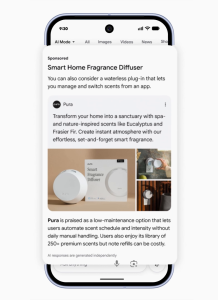
What Are Ads in Google AI Mode?
AI Mode is Google’s conversational search experience. Rather than returning a traditional list of blue links, it uses artificial intelligence to create a detailed response from multiple sources. Users can then ask follow-up questions, add more context and narrow down their options without starting a completely new search.
Ads in AI Mode are designed to appear when Google identifies a relevant commercial opportunity within that conversation.
Picture someone asking:
“What type of running shoe is best for a beginner training for their first half marathon?”
AI Mode might explain the differences between cushioning, stability and neutral running shoes. The user could then add:
“I have flat feet, run mostly on roads and want to spend less than £120.”
At this point, Google understands considerably more than it would from a traditional search for “running shoes”. It knows the customer’s experience level, intended use, physical requirements, preferred surface and budget.
A relevant product or business could then be introduced within the response – not simply because it matched a keyword, but because it matched the wider context of the conversation.
That is the real change. Google is moving from matching ads to individual search terms towards matching businesses with detailed, evolving customer needs.
Where and When Will AI Mode Ads Appear?
Google is testing and introducing several advertising experiences across its AI-powered search products. Their availability, appearance and rollout can vary by market, account and campaign type, so UK businesses should not assume that every announced format will be immediately available to every advertiser.
The formats announced by Google include:
Conversational Discovery ads: these are designed to introduce relevant businesses, services or products while someone explores a topic through a conversation.
Highlighted Answers: these allow an advertiser’s relevant information to be presented as a prominent answer when it closely matches what the user wants to know.
AI-powered Shopping ads: these can provide product recommendations alongside AI-generated explanations of why a particular item may suit the customer’s requirements.
Ads can also appear within AI Overviews, Google’s AI-generated summaries displayed above or among traditional search results.
The important point is that these placements are not necessarily tied to the first question someone asks. An advertising opportunity might emerge several follow-up questions into the conversation, once Google has gathered enough context to understand what the user actually needs.
For advertisers, that means the customer journey is becoming less linear, but potentially much more specific.
From Keywords to Conversations
Traditional paid search has always been built around keywords and search terms.
Someone searches for “accountant Chichester”, an advertiser bids on a closely related keyword, and Google decides which ads are eligible to appear.
That model is already more sophisticated than it sounds. Google considers factors including intent, relevance, landing-page experience, location, campaign settings and the likelihood of a conversion. However, AI Mode takes contextual understanding considerably further.
A conversational search might include:
- The problem someone wants to solve
- Their budget
- Their location
- Previous experience
- Product or service preferences
- Features they do or do not want
- Questions about suitability
- Comparisons with other options
- Concerns preventing them from making a decision
Instead of treating every query as a separate event, AI Mode can use the context gathered throughout the conversation.
This does not mean keywords will suddenly become irrelevant. They still provide valuable information about demand, commercial intent and the language customers use. However, relying on a tightly controlled list of exact terms will become increasingly limiting if Google is evaluating the meaning behind an entire conversation.
The strongest campaigns will combine keyword insight with a much deeper understanding of the customer.
What Does This Mean for Search Intent and Targeting?
AI Mode makes search intent more detailed and more dynamic.
A broad informational question can become commercial after one or two follow-ups. Someone may begin by asking how a product works, move on to comparing different options and then ask where they can buy the most suitable one locally.
In a traditional funnel, marketers might label these as separate awareness, consideration and conversion stages. In AI Mode, they can all happen within the same conversation.
That creates an opportunity for businesses that understand the full decision-making process behind a purchase.
It is now important to think beyond “Which keywords should we bid on?” and start asking:
- What problem is the customer trying to solve?
- What information do they need before they are ready to buy?
- Which comparisons are likely to influence them?
- What objections might stop them converting?
- Which features matter most to different types of customers?
- What evidence would make our business the most relevant choice?
This is closely connected to query fan-out. Google can break a complex request into multiple related searches and explore different aspects of the user’s intent before forming a response. Paid-search strategies therefore need to account for a wider network of needs, questions and product attributes – not just one headline search term.
Your Landing Pages Will Matter More, Not Less
More intelligent targeting cannot rescue a poor landing page.
If Google introduces your business as the answer to a detailed customer need, the page behind that recommendation must support the same level of relevance. A generic homepage with little useful information is unlikely to provide a strong experience for someone who has already explained precisely what they want.
Landing pages should clearly communicate:
- Who the product or service is for
- Which problems it solves
- Important features and benefits
- Pricing or an indication of cost
- Availability and location
- Delivery or service information
- Reviews, accreditations and other trust signals
- Answers to common questions
- A clear next step
The closer your landing page matches the customer’s real intention, the better chance you have of turning AI-driven visibility into a meaningful enquiry or sale.
Page speed, mobile usability and conversion tracking remain essential too. The search experience may be changing, but customers will still leave a slow, confusing or unconvincing website.
Product Data Is Becoming Critical
For e-commerce businesses, product data will play a central role in AI-powered advertising.
If Google is going to recommend a specific product for a detailed request, it needs accurate, well-structured information about what that product is and why it is relevant.
That includes:
- Clear product titles
- Detailed descriptions
- Accurate prices
- Current availability
- High-quality images
- Sizes, colours and materials
- Product specifications
- Delivery and returns information
- Reviews and ratings
- Relevant Merchant Centre attributes
Thin or inconsistent product feeds give Google less information to work with. A beautifully designed advert cannot compensate if the underlying product data is incomplete, inaccurate or out of date.
In AI search, your product feed is no longer just an administrative requirement. It is part of the information infrastructure Google uses to understand, compare and recommend what you sell.
Creative Still Has a Job to Do
As targeting becomes more automated, strong creative becomes more valuable.
Google may decide when and where a business is relevant, but advertisers still need to give the system useful, accurate and distinctive assets. Generic copy will struggle to communicate why one business deserves to be chosen over another.
Your creative should clearly express:
- What makes your business different
- Which customer needs you serve best
- The practical benefits of choosing you
- Evidence supporting your claims
- The offers or incentives available
- The questions customers frequently ask
This information should remain consistent across your adverts, landing pages, website content and product data.
AI can assemble and adapt the message, but it still needs high-quality ingredients.
Will Ads in AI Mode Cost More?
The honest answer is that we do not yet know what the long-term cost of AI Mode advertising will look like.
Costs will depend on factors such as demand, competition, campaign type, bidding strategy, placement availability and how Google develops the product. New placements do not automatically mean cheaper clicks, and increased automation does not guarantee better results.
The better question is not simply “How much will an AI Mode click cost?” It is:
“What is a qualified customer acquired through AI Mode worth to our business?”
If these conversations enable Google to identify people with stronger intent and a better fit for a product or service, the resulting clicks could be more valuable. But that still needs to be demonstrated through conversion and revenue data.
Until enough evidence is available, businesses should test carefully, protect their budgets and judge performance by commercial outcomes rather than novelty.
What Should Be Measured Beyond Clicks?
Clicks will remain useful, but they will not tell the whole story.
AI-powered search journeys may involve more research before a user reaches your website. Some customers could encounter a business within an AI response, continue asking questions and return later through a branded search or another channel.
It is important to now pay attention to:
- Conversion quality: are the resulting enquiries genuinely relevant, or are they simply increasing lead volume?
- Revenue and profitability: are campaigns generating commercially valuable customers once advertising costs are included?
- Cost per qualified lead: how much are you paying for a lead that meets your actual criteria?
- Assisted conversions: did paid search contribute to a sale that was completed through another channel?
- Branded demand: are more people searching for your business by name after encountering it elsewhere?
- Customer lifetime value: are campaigns attracting customers who buy once, or customers who create longer-term value?
- Offline results: for businesses that convert leads through telephone calls, appointments or sales teams, offline conversion tracking will become particularly important.
The closer your reporting gets to real business outcomes, the better equipped you will be to assess whether AI-powered advertising is working.
The Trade-Off: Greater Relevance, Less Control
AI Mode advertising presents both an opportunity and a risk.
The opportunity: Google may be able to understand a customer’s needs in far more detail, helping businesses reach people with stronger intent and more specific requirements.
The risk: advertisers may have less visibility into exactly which searches, conversational steps and matching decisions caused their business to appear.
More automation can make campaigns easier to scale, but it can also make poor data, weak positioning and inaccurate conversion tracking more expensive.
Businesses should not confuse automation with a strategy. Google can decide how to deliver an advert, but it cannot decide what makes your company commercially valuable or which customers you genuinely want to attract.
That work still belongs to the marketer.
Quick Takeaways
- Google is introducing advertising formats designed for AI-powered and conversational search experiences.
- Ads may appear as users explore, compare and refine their needs within AI Mode.
- Keywords still matter, but complete customer intent is becoming increasingly important.
- Strong landing pages, accurate product data and distinctive creative will give AI systems better information to work with.
- The future cost of AI Mode advertising is still uncertain, so businesses should test carefully.
- Success should be measured through qualified leads, revenue and profitability – not clicks alone.
- AI-powered advertising is not replacing paid-search strategy. It is making good strategy and reliable data more important.
The Final Say
Paid search is not disappearing. It is moving deeper into the customer’s decision-making process.
The winning businesses will not necessarily be those with the longest keyword lists or the fastest access to every new Google feature. They will be the ones that understand their customers in the most detail, communicate their value clearly and give Google accurate information about what happens after the click.
Search advertising has always been about matching demand with the right solution. AI Mode simply gives Google more of the conversation.
The question is whether your marketing gives it the right answer.
At Fandango Digital, we help businesses build strategic, data-driven PPC campaigns that focus on the outcomes that matter. If you would like to understand how AI-powered search could affect your advertising, or whether your current campaigns are ready for what comes next, get in touch with our friendly team. We’d love to chat.

